
It's unfair, isn't it? That good borrowers are not rewarded for their discipline and are forced to subsidise indisciplined borrowers who may pose higher credit risk...

As floods hit the low-lying areas in the national capital, slum dwellers whose houses got submerged claimed that they were not alerted beforehand and many others alleged that help was not forthcoming from the administration.

Approval to the long-awaited Banking Laws Amendment Bill by Parliament towards the end of 2012 has paved the way for enhanced banking space and may see entry of new players and mergers and acquisitions in the sector in the coming year.
Did your bank ever reject your loan application because you were reported falsely for having bad credit history? Tell us.

The S&P BSE Sensex dropped 1 points to end at 26,396 and the Nifty50 slipped 2 points to end at 8,109.

Once these banks start showing losses, they will not be able to pay dividends to the government nor pay taxes, which will further aggravate the situation for the government as its return on investment as an investor would be very negligible for the next few years, says M V Subramanian.

Two straight years of less than 5 percent economic expansion have led to a surge in bad loans for Indian lenders.

RBI moves to restrict bank exposure to corporate loans.
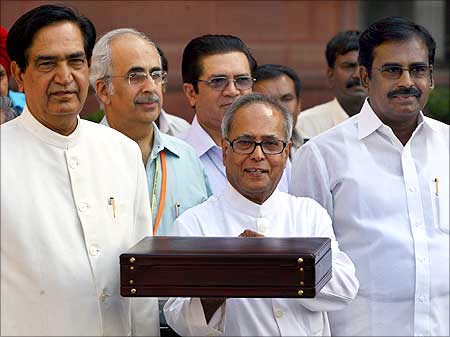
The sad truth is that the debt-to-GDP ratio will shoot up close to 90 per cent in the coming year, and the fiscal deficit glide path does not promise to reduce it substantially any time soon, predicts Mihir S Sharma.

The unions have also threatened to explore an indefinite strike option, if their demands were not addressed.

Share prices of Dewan Housing, Indiabulls Housing, and PNB Housing have declined 30-80% in the past one year

The scrip was the worst hit among the front-line companies on both the indices during the day.
Rush to offload bad loans indicates a revival in asset-sale market

The reason for the stickiness in bond yields can be many, but the most responsible is the liquidity deficit stance taken by RBI, says Anup Roy.

The speed at which he led the central bank in different areas -- ranging from internal reorganisation to inflation fighting, stabilising the currency, taking on rogue corporations, cleaning up bank balance sheets, and opening the sector -- makes one believe that Rajan knew he had only three years to do his job. A fascinating excerpt from Tamal Bandyopadhyay's MUST-READ Roller Coaster: An Affair with Banking.

Bankers seem to be pleased with the government for keeping its promise of not interfering in operational matters, but are apprehensive about the intense scrutiny of their functioning.

A giant effigy of embattled FIFA president Sepp Blatter will be set alight as part of the Bonfire Night celebrations of a small English town.

In the case of Iran, the lifting of sanctions has paved the way for direct relations.

Mukesh Ambani remains the country's wealthiest promoter as his stake in Reliance is now worth Rs 3.25 trillion!
Federal Reserve chairman Ben Bernanke touched off the biggest one-day rally in US stocks this month by hinting that the Central Bank is almost done with raising interest rates. The indices had their biggest rise since June 29.

Unless RBI temporarily relaxes the norms on recognising of bad loans, the pressure on this front could rise in the December quarter.

State Bank of India and IDBI Bank have decided not to go to the IIMs this year.
The haircut for major banks stands at 52 per cent, if the dues of Jaypee Infrastructure, Lanco Infrastructure and Era Infrastructure are kept out of the calculation.

Anup Roy and Krishna Kant on the challenges the public sector banks face in revitalising themselves

A mentor can only help as much because it is the players who will have to go out there and perform the "actual task", the legendary Sunil Gavaskar said on the appointment of Mahendra Singh Dhoni as the Indian team mentor for the T20 World Cup.

North East were 65 for 2, 475 runs in arrears, when bad light and rain forced an early closure to their first dig on Thursday.

Dy Governor notes it's an era of job changes for better.

Sharma to step down as Axis Bank chief on December 31.

The country's economy will start witnessing a growth of 6.5 to 7 per cent from fiscal 2023 onwards, helped by various reforms undertaken by the government so far and also as COVID-19 vaccination drive progresses, Chief Economic Advisor Krishnamurthy Subramanian said. He said the second wave of COVID-19 is unlikely to have a very significant on the economy. The country's economy contracted by 7.3 per cent in fiscal 2020-21. "Together with the reforms and focus on vaccination, I expect growth to start hitting close 6.5 to 7 per cent from FY23 onwards and accelerate from there on," Subramanian said at a virtual event organised by Dun & Bradstreet.

While some states like Kerala and Telangana were badly hit by the strike, the impact was partial in Punjab, Haryana and Maharashtra

The association also wondered how the brand value of Kingfisher was considered as a collateral while sanctioning a loan, and alleged that even when RBI knew that this was a "deliberate default", no action was taken by the banks.


'SBI is already too big. Too big to fail.' 'It already is a moral hazard. What will it do with 20,000 branches that it cannot do with 14,000, especially in these days of online and mobile banking?'

Replying to a question on charges of money laundering by certain employees of three private sector banks, Chidambaram said the RBI and the Finance Ministry are looking into the issue.

The unions have called for a strike against proposed closure of associate banks and their merger with the State Bank of India

Emotional Tickner returns to NZ squad after cyclone relief efforts

The bank's overall exposure to the 40 select accounts referred by the Reserve Bank to be resolved under bankruptcy laws is Rs 15,229 crore
They need to have 15 years of mainstream banking experience

Companies that loaded up on debt when India was being hailed as the world's second-fastest-growing economy are now deleveraging to clean up their balance sheets.

The combined market capitalisation of the 21 listed PSU banks declined by about Rs 76,000 crore to Rs 425,800 crore during the month.
 © 2026 Rediff.com - Advertise with us - Disclaimer - Privacy Policy - Sitemap - Feedback - About us - Terms of use - Grievances